CLIENT RETENTION · B2B AGENCIES
Client renewal risk: 7 warning signs to spot 90 days out
Spot client renewal risk 90 days out: 7 warning signs, a review routine and a B2B key account management approach to keep your best clients.
Most client renewals are not lost in the renewal meeting. They are lost quietly in the three months before it, when a sponsor stops replying, a review is postponed, or a question about the invoice goes unanswered.
The good news is that client churn rarely arrives without warning. The signs are usually visible to the people closest to the account. The problem is that nobody is looking for them on a schedule, so they get noticed in the final week, when there is little left to change.
This guide explains what client renewal risk is, the seven warning signs worth checking about 90 days before a renewal, and how to turn them into a short, repeatable routine. It is written for agency founders, account managers and delivery leads who want better client retention without building a complex system.
What client renewal risk actually means
Client renewal risk is the chance that a client will not renew, will renew on much smaller terms, or will renew while privately planning to leave. It is a judgment about the next contract date, not a verdict on the work you have already done.
That distinction matters. Plenty of agencies deliver good work and still lose accounts, because the people who decide on renewal never saw the value, a new leader arrived with different priorities, or a budget changed. Renewal risk covers all of those cases, which is why it is broader than delivery quality.
It also differs from churn rate. Churn rate tells you how many clients you lost after the fact. Renewal risk looks forward, at the clients who are still with you, and asks which ones deserve a conversation now. Both belong in your client retention routine, but only one gives you time to act.
Why 90 days out is a useful moment to check
A renewal decision rarely happens on the contract date. Budgets are planned earlier, internal approvals take time, and a client who is leaning toward leaving often starts looking at alternatives weeks before they tell you.
Ninety days is a working rule, not a benchmark, and the right number depends on your contracts. For a monthly retainer with a thirty-day notice period, you may want to check earlier. For an annual contract with a formal procurement process, you may need more than ninety days. Pick the point at which you still have room to change what the client experiences.
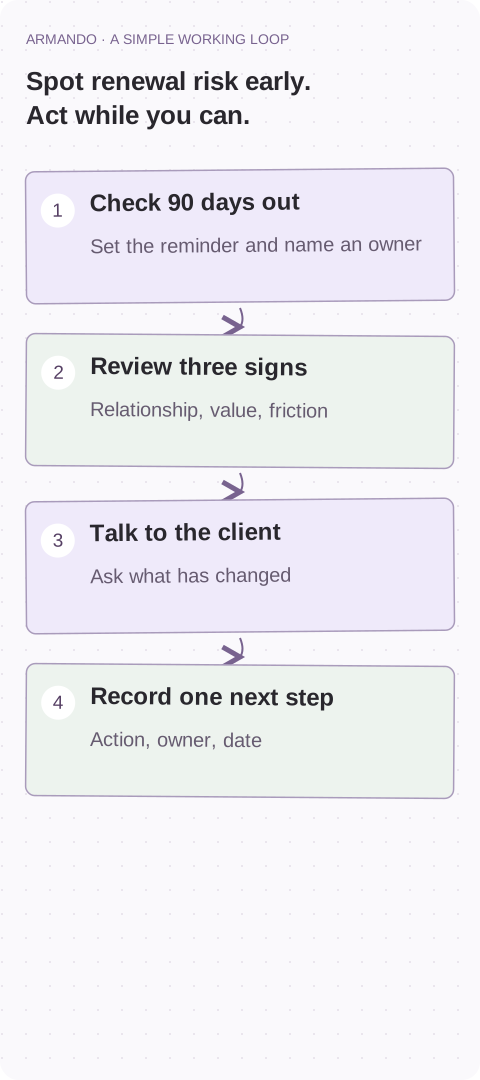
The aim of the check is modest. You are not predicting the future. You are making sure that someone on your team has looked at each renewal with fresh eyes, and that the account has an owner and a next step before the date arrives.
- Add every renewal date to the client record, with the notice period next to it.
- Set a reminder for roughly 90 days before the earlier of the renewal date and the notice deadline.
- Name one account owner who is responsible for the review.
- Block 30 minutes for the review, so it happens even in a busy month.
Warning signs 1 and 2: the relationship is thinning
Sign 1: the main contact goes quiet. Replies take longer, messages get shorter, and invitations to catch up are met with polite delays. Everyone's inbox gets busy, so one slow week means little. A steady change over several weeks is worth noticing, especially if the client used to respond within a day.
Sign 2: the sponsor or champion changes. A promotion, a reorganisation, or a departure can leave you with a relationship that was built on one person. The new decision-maker may not know why the work started, what has been achieved, or why your agency was chosen. Treat a change on the client side as a restart of the relationship, even when the work itself is going well.
Both signs point to the same question: who actually decides about renewal, and when did you last speak to each of them? Many agencies discover that their only contact is not the person who signs.
How to build B2B client relationships ↗
- List everyone who influences the renewal decision, including the person who approves the budget.
- Note when you last spoke with each person and what you discussed.
- Ask your main contact who else cares about the results of this work, and request an introduction.
- Offer a short welcome conversation to any new sponsor within their first weeks.
Warning sign 3: reviews and meetings start slipping
Clients who value a relationship protect time for it. When regular check-ins are postponed twice in a row, shortened to fifteen minutes, or attended by someone more junior each time, the relationship may be moving down the client's list of priorities.
Look at the pattern, not a single event. A rescheduled call before a product launch is normal. A quarterly business review that has not happened for two quarters is a different signal, because the agreed place to discuss value and plans has quietly disappeared.
Silence is the hardest version of this sign, because there is no event to point at. A client who never complains, never asks questions and never suggests ideas may be comfortable. They may also have mentally moved on. Do not read silence as satisfaction without asking.
- Count how many scheduled reviews took place in the last six months.
- Check who attended on the client side and whether seniority changed.
- Replace a cancelled review with a short, specific invitation, such as a twenty-minute conversation about next quarter's priorities.
Warning sign 4: the client cannot see the value
Good work can still be invisible. A client may receive deliverables every week and still be unable to say what changed in their business. When that happens, renewal becomes a conversation about cost rather than value.
Warning signs include goals that were agreed at kickoff and never revisited, results the client describes as activity ("you send us reports") rather than outcomes, and questions like "what exactly are we paying for?" Treat that question as an invitation. The client is asking you to show your work.
Another version appears when the client's priorities change without a conversation. If the business is now focused on a new market, a cost-saving programme, or a different product, your plan may be answering last year's question. Keeping the plan aligned with the client's current goals is one of the most effective client retention habits you can build.
B2B account management plan template ↗
- Write down the goal you agreed with the client and note whether it is still the goal today.
- Collect two or three results the client has acknowledged, using their own words where possible.
- Prepare a short summary of value delivered and a proposed focus for the next quarter.
- Share it before the renewal conversation, not during it.
Warning signs 5, 6 and 7: commercial and delivery friction
Sign 5: scope reductions. A request to cut a deliverable, pause a workstream or reduce hours can reflect a genuine budget decision. It can also be the first step of a client leaving gradually. Ask what changed before you assume either.
Sign 6: contract and invoice questions. Repeated queries about invoices, requests to see the contract terms, or questions about the notice period deserve attention. Each may have an ordinary explanation, such as a new finance owner. Together they suggest the client is weighing options.
Sign 7: delivery friction. More escalations than usual, slower approvals, or rising frustration about small mistakes can mean trust is eroding. The visible problem may be small, while the real issue is that the client feels less confident that you will handle things well.
None of these signs proves that a client will leave. What they share is a change from how the account normally behaves. A good rule is to compare against the last six months of the same account rather than against other clients.
| Warning sign | What you might notice | First move |
|---|---|---|
| 1. Main contact goes quiet | Slower replies, shorter messages, fewer ideas from the client | Reach out with a specific, useful question rather than a generic check-in |
| 2. Sponsor or champion changes | New decision-maker, reorganisation, someone you have not met | Request an introduction and offer a short welcome conversation |
| 3. Reviews start slipping | Postponed or shortened meetings, more junior attendees | Replace the review with a short call about next quarter's priorities |
| 4. Value is hard to see | Goals never revisited, questions about what the client is paying for | Restate the goal and bring results the client has acknowledged |
| 5. Scope shrinks | Requests to cut deliverables or hours | Ask what changed and agree what matters most |
| 6. Contract and invoice questions | Queries about notice periods, terms or invoices | Check who asked and why, then talk to the sponsor |
| 7. Delivery friction | More escalations, slower approvals, frustration over small errors | Acknowledge the issue, agree a fix and follow up in writing |
- Review the last three months of scope, billing and approval changes for each upcoming renewal.
- Decide whether the issue is delivery, expectations or budget, and write down the evidence.
- Raise it directly with the client rather than waiting for the renewal conversation.
How to run a 90-day client renewal review in 30 minutes
The review works best when it is short, regular and written down. Gather the account owner and, if useful, whoever leads delivery, and walk through the seven signs for one client at a time.
For each sign, separate what you know from what you are guessing. "The sponsor has not joined the last two calls" is a fact. "They are unhappy" is a guess. Writing both down stops the team from treating worries as certainties, and it shows you which questions to ask the client.
End every review with one next step, an owner and a date. A review that produces a feeling of concern but no action does not change the outcome.
- Pick the clients whose renewal or notice date falls in the next 90 days.
- Check each of the seven signs and mark it as seen, not seen, or unknown.
- Write what you know, what you are guessing, and what you still need to find out.
- Agree one next step with an owner and a date.
- Schedule the next check for the same account in 30 days.
COPY & ADAPT
Renewal check: [client]
Renewal date / notice deadline: [date]
Account owner: [name]
Signs seen: [list the numbered signs]
What we know: [facts only]
What we are guessing: [open questions]
Who decides on renewal: [names and last contact]
Next step: [action] by [date], owner [name]
How to talk to the client about renewal without making it awkward
A renewal risk review is internal, but it only helps if it leads to a conversation with the client. Aim for a tone of curiosity. You are not asking them to justify a decision. You are asking how the work is landing and what matters next.
Open questions work better than reassurance. "What would make the next quarter more valuable for you?" invites a real answer. "Are you happy with us?" invites a polite one. If a sign points to a specific problem, name it gently and ask for the client's view rather than assuming a cause.
If the client reveals a concern, resist the urge to defend. Thank them, repeat back what you heard, and agree what you will do and by when. A client who raises a problem and sees it handled is often more confident afterwards than one who never raised anything.
- Ask what has changed in the client's priorities since the work began.
- Ask what would make the next quarter more valuable.
- Ask who else should be involved in decisions about the work.
- Confirm what you heard and what happens next, in writing.
COPY & ADAPT
Subject: Planning the next quarter together

Hi [name],

As we approach [renewal date / next quarter], I would like to make sure our work is focused on what matters most to you right now. Could we spend 20 minutes on three questions: what has changed in your priorities, which results matter most this quarter, and who else should be part of the conversation?

I will bring a short summary of what we have achieved together and a proposal for the next phase.

Would [day] or [day] work?

Best,
[your name]
Turn it into a client retention routine: 90, 60 and 30 days
A single review helps. A routine protects every renewal. Many small agencies get good results from three simple checkpoints, each with a different purpose.
At 90 days, you review the seven signs and agree a next step. At 60 days, you check that the next step happened, and you share a value summary and a proposed plan with the client. At 30 days, you confirm who will sign, resolve open questions, and prepare the renewal terms so that nothing surprises either side.
If you already track a customer health score, use it as a prompt for the same conversation. A score can show patterns across many accounts, but it cannot tell you why a particular sponsor stopped replying. Speaking to the client does.
| Checkpoint | Purpose | Output |
|---|---|---|
| 90 days | Review the seven signs and decide whether the account needs attention | Renewal check note with one next step |
| 60 days | Confirm the next step happened and share value delivered | Value summary and proposed plan sent to the client |
| 30 days | Confirm decision-makers and resolve open questions | Renewal terms ready and no surprises |
Where renewal risk fits into B2B key account management
Key account management is the practice of giving your most important clients a dedicated owner, a plan and a regular rhythm, instead of treating every relationship the same. In a B2B agency, it usually means that a small group of clients, often the ones that bring the most revenue or the best long-term potential, gets more deliberate attention from a key account manager.
Renewal risk is the early-warning part of that system. A key account plan describes where you want the relationship to go. A renewal review tells you whether the relationship is on track to get there. Without the second, a plan can look healthy on paper while the sponsor quietly stops replying.
Strategic account management takes the same idea further. It looks beyond the next renewal to the client's wider goals, the other teams you could help, and the people you need to know across the organisation. The seven warning signs in this guide help here too. A thinning relationship, for example, is also a sign that your key account strategy depends on too few people.
You do not need a large team to do this well. Choose your five or ten most valuable accounts, name one owner for each, and run the 90, 60 and 30 day routine on those first. Then widen it to the rest of your clients as the habit settles.
A simple account management system for agencies ↗
B2B account management plan template ↗
- Choose the clients that matter most by revenue, strategic value or growth potential.
- Give each one a named key account manager and a written key account plan.
- Add the renewal review to each plan, with dates for the 90, 60 and 30 day checkpoints.
- Review the full list once a month so that nothing depends on one person's memory.
Common mistakes when assessing client renewal risk
Treating one sign as a verdict. A single quiet week is rarely meaningful. Look for patterns and combinations, and keep asking until you understand the cause.
Labelling an account as at risk without evidence. Once a client is labelled, the team starts to treat them differently, and the label can become self-fulfilling. Write down the evidence next to every label.
Waiting for the client to raise it. Clients rarely announce concerns before a renewal. If you are not asking, you are probably not hearing.
Reviewing only the big accounts. Smaller clients can be easier to retain and easier to forget. Even a short check of each renewal is better than none.
Leaving the review without an owner. The most common failure is not missing the signs. It is agreeing that something should be done and then not assigning it to a person with a date.
Start with one account this week
- List every client whose renewal or notice date falls in the next 90 days.
- Check each account against the seven warning signs and mark what you know and what you are guessing.
- Identify who actually decides on renewal and when you last spoke to them.
- Agree one next step with an owner and a date for each account.
- Book the client conversation instead of waiting for the renewal notice.
Common questions
What is client renewal risk?
Client renewal risk is the chance that a client will not renew, will renew on much smaller terms, or will renew while planning to leave. It looks forward at current clients, unlike churn rate, which measures clients you have already lost.
What is key account management in a B2B agency?
Key account management means giving your most valuable clients a dedicated owner, a written plan and a regular rhythm of reviews, so that relationships are managed deliberately rather than left to chance. Renewal risk checks are one of its core routines.
How early should an agency review renewal risk?
Around 90 days before the renewal or notice deadline is a useful starting point. Adjust it to your contract length, notice period and how long your clients take to make decisions.
Does one warning sign mean the client will leave?
No. Each sign can have an ordinary explanation. Treat them as prompts for a conversation, and look for patterns and changes from how the account normally behaves.
What if the client says everything is fine but I still see warning signs?
Keep the conversation open. Ask specific questions about priorities, results and who else is involved in decisions. Polite reassurance and real satisfaction can look similar, so check the facts.
Do we need a customer health score to track renewal risk?
No. A short, regular review with a named owner is enough to start. A health score can help you see patterns across many accounts later, but it does not replace speaking to the client.
Who should own client renewal risk, the key account manager or delivery?
One named person should own the review, usually the key account manager or account lead. Delivery leads should contribute what they see, because early signs often show up in day-to-day work first.