ACCOUNT EXPANSION · B2B AGENCIES
B2B account expansion: grow agency clients without pushing an upsell
B2B account expansion strategies for agencies: find the next client problem, build a business case, and scope a useful pilot before proposing more work.
“We can also do design, data, and strategy” is a service list. It is not a reason for the client to buy. A useful growth conversation connects a problem they care about with work your agency can deliver well.
Fix a struggling engagement before proposing expansion. If delivery is late or your last promise is unresolved, start there.
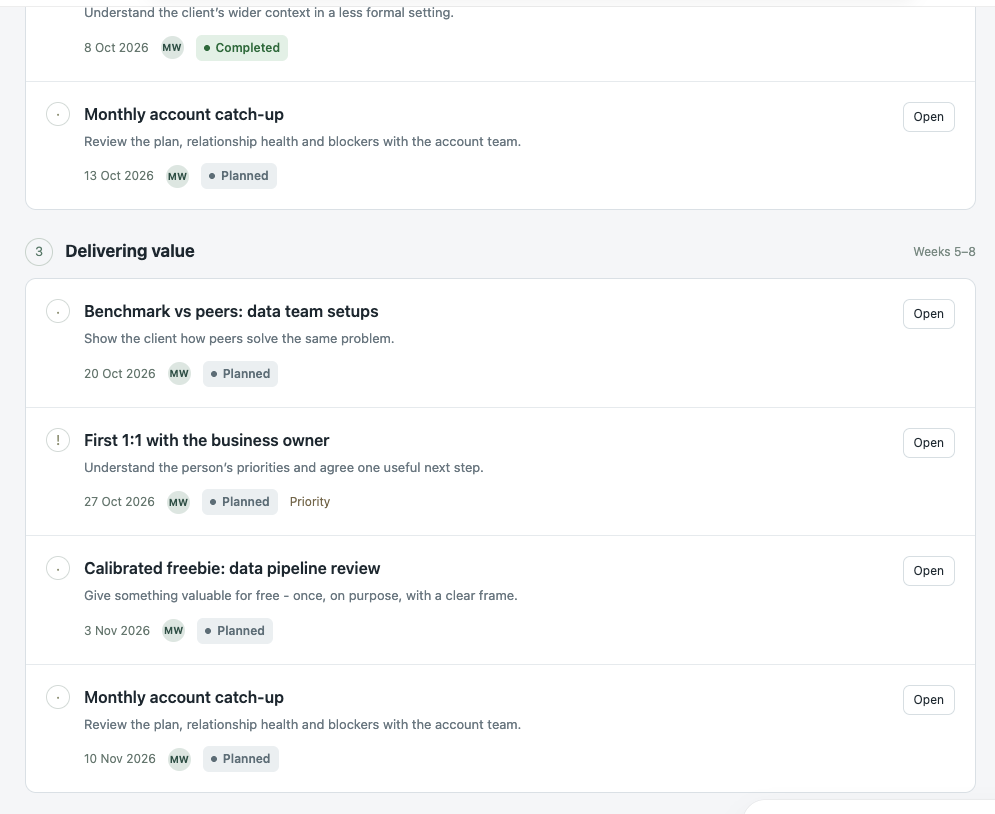
Our original sheet included useful contributions, follow-ups, and opportunities—not only sales calls. The practical sequence below turns that rhythm into a client-led growth conversation.
1. Check whether the account is ready
Before discussing more work, check the current agreement. Can the client explain the value they received? Are important commitments complete? Does the sponsor have a priority you understand? If the answer is unclear, investigate rather than labeling the account an opportunity.
- Review the last client conversation and open promises.
- Confirm the business outcome, not just completed deliverables.
- Ask the delivery lead what capacity and expertise are actually available.
2. Find the next problem before naming the service
Talk about the client’s plans and constraints. A new team, a stalled launch, or a recurring manual process can reveal a useful next problem. None automatically creates a sales opportunity; the client has to care enough to act.
COPY & ADAPT
What is the next thing your team needs to achieve? Where is progress getting stuck? Who else is affected? What happens if this stays unresolved? Is there already a plan or budget to address it?
3. Give useful context with a clear boundary
A short comparison, a workshop, or a narrowly bounded review can help a client decide. If you offer a small free diagnostic, define the time and output in advance. Do not quietly turn discovery into unpaid delivery. Explain uncertainty rather than inventing an ROI figure.
- Write the problem and the evidence you have. Separate observed facts from assumptions.
- Identify the sponsor, day-to-day owner, and person who can approve spending.
- Describe two viable options, including staying with the current approach.
- State the expected benefit and how you would test it.
4. Propose a paid pilot with a decision at the end
A small pilot limits commitment while you learn. Define its duration, scope, client inputs, price, and acceptance criteria. Do not promise a wider rollout before you know the result.
COPY & ADAPT
Problem: [client priority and evidence]
Pilot: [bounded work and dates]
Outcome to test: [measure, starting point, and agreed success criterion]
Client inputs: [owner, access, decisions]
Price and limits: [fee, included work, exclusions]
Review: [date and people who decide whether to continue]
5. Review value and account economics
Compare the pilot result with the agreed starting point. If the evidence is weak, say so and decide whether to stop, adjust, or collect more information. A successful small project is an invitation to discuss the next step, not automatic permission to expand.
Track expansion revenue separately from price changes and pass-through costs. If you use net revenue retention, calculate (opening recurring revenue − churn − contraction + expansion) ÷ opening recurring revenue × 100 for the same client cohort and period. Exclude revenue from new clients. Project agencies may be better served by revenue and contribution per account than a forced subscription metric.
Start with one account this week
- Resolve an open promise before discussing more work.
- Ask about one new priority and who owns it.
- Write a one-page option with a bounded pilot.
- Set a review date and agree how success will be measured.
Common questions
What is upselling versus cross-selling for an agency?
Upselling increases the scope or level of an existing service. Cross-selling adds a different service. Both should address a confirmed client need and fit your delivery capability.
When should an agency discuss expansion?
After the client sees useful progress and a relevant new need emerges. A QBR can provide the setting, but an unresolved delivery issue should be addressed first.