ACCOUNT PLANS · B2B AGENCIES
A simple B2B account management plan template—with examples
A copyable B2B account management plan template for agencies: client goals, stakeholders, 90-day actions, risks, and practical retention and growth examples.
A delivery board tells you what the team is building. An account plan tells you why the client cares, who you need to talk to, and what should happen to the relationship next. You need both, but they do different jobs.
Do not fill in every field because a template asks for it. Start with one clear account objective, source your assumptions, and keep the plan easy to hand over.
Our first version was a Google Sheet. Annual plans and stakeholder mapping came later. The template below keeps the same principle: enough context to make the next action clear.
1. Copy this one-page account plan
Keep the document in the place your team actually uses. Link to evidence rather than duplicating entire meeting transcripts. Record the date of the last meaningful update.
COPY & ADAPT
ACCOUNT: [client]
OWNER / BACKUP: [people]
CLIENT GOAL: [their words, source, date]
12-MONTH DIRECTION: [agreed ambition or explicitly unconfirmed assumption]
90-DAY ACCOUNT OBJECTIVE: [one useful change]
PEOPLE: [sponsor, decision maker, delivery contact, interests]
VALUE SO FAR: [outcome and evidence link]
RISKS / UNKNOWNS: [issue, source, response]
NEXT ACTIONS: [action / owner / due date / definition of done]
NEXT COMMERCIAL DECISION: [date and owner, or unknown]
REVIEW: [next date and what to decide]
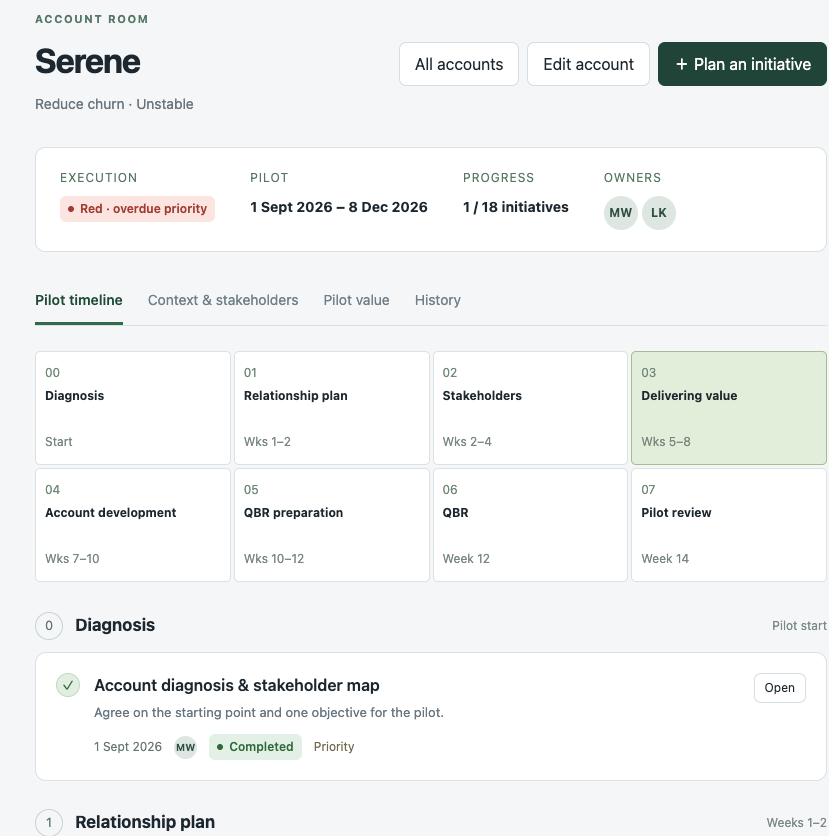
2. Example: an account that needs stabilizing
Illustrative account: a consulting client’s sponsor changed. Delivery continues, but the new sponsor has not confirmed the business goal. The objective is to agree priorities and rebuild a working relationship—not to invent a churn probability.
- Week 1: the account owner asks the current contact for an introduction and shares a short context memo. Done = introduction agreed or the blocker recorded.
- Week 2: the owner and new sponsor confirm priorities and the next decision. Done = the client has corrected the written summary.
- Next review: delivery and account owners check whether work matches those priorities. Escalate gaps and record the next action.
3. Example: a stable account with a possible new need
Illustrative account: an existing delivery team has identified a manual reporting bottleneck. The account objective is to understand whether another team needs help. No opportunity value is assigned before the client confirms the problem and budget process.
- Ask the delivery contact for context and permission to speak with the affected owner.
- Have a problem conversation; record the current approach, impact, and constraints.
- Offer a bounded paid discovery if it is useful and within your capability.
- At the review, decide whether to stop, adjust, or propose delivery.
4. Turn the plan into a working rhythm
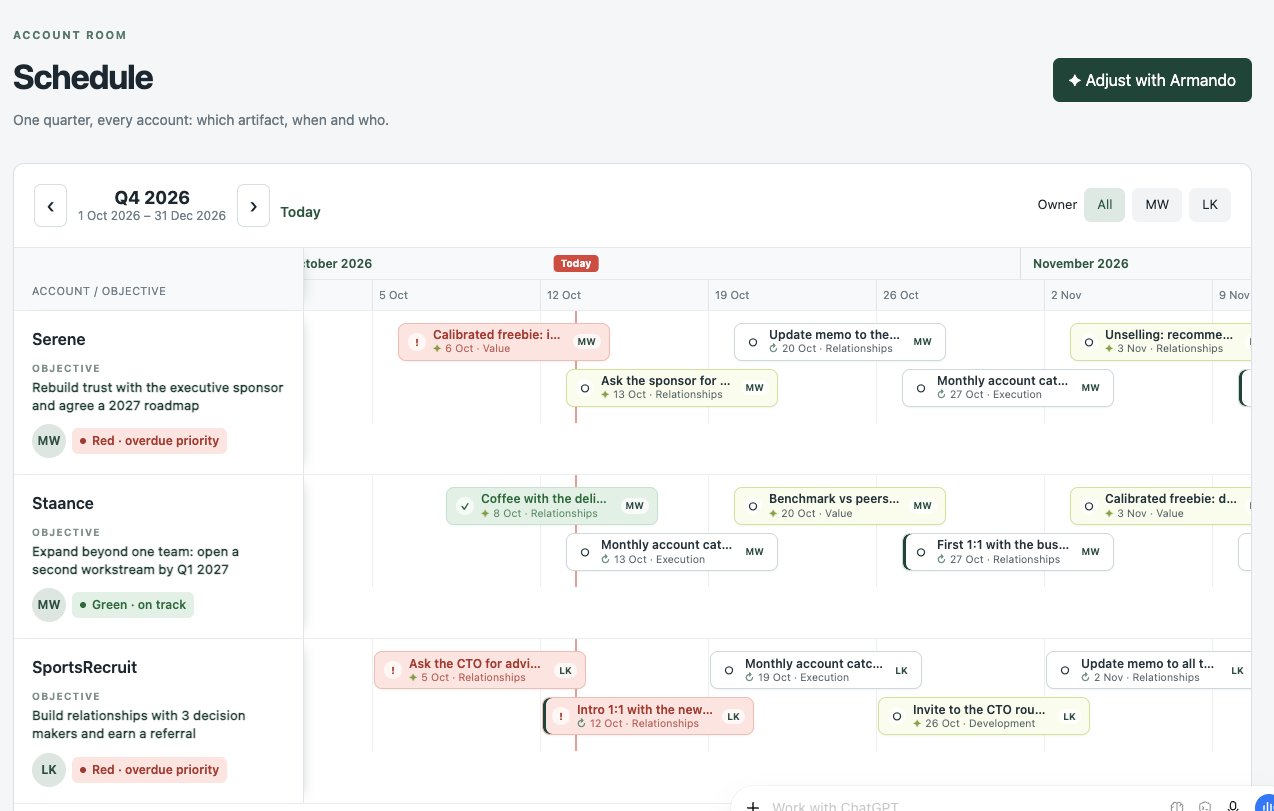
For a starter cadence, review open actions briefly each week, reassess account priorities monthly, and use the QBR to agree the next quarter with the client. Adapt that rhythm to the engagement and the client’s preferences. A coffee, memo, or workshop only belongs in the plan if it has a purpose.
Use a quarterly schedule to see owner capacity across accounts. Too many planned touchpoints that nobody can execute are less useful than a smaller plan with real follow-through.
5. Make the plan survive a handover
Ask the backup owner to read it and explain the client’s current priority, open risk, and next action. If they cannot, the missing context still lives in somebody’s head. Link to agreements and notes with their dates, and check permissions before sharing.
Keep a short decision log. When a goal changes, retain why it changed instead of silently replacing it. The point is continuity—not an archive nobody can navigate.
Start with one account this week
- Copy the template for one account.
- Verify one goal with the client and add its source.
- Choose one objective and three realistic next actions.
- Have the backup owner explain the plan back to you.
Common questions
How long should an account plan be?
Start with one page and links to supporting material. Add detail only when it helps someone make a decision or continue the relationship.
Is an account plan the same as a project plan?
No. A project plan organizes delivery. An account plan connects client goals, people, risks, value, and relationship actions across the engagement.