FOUNDER PLAYBOOK · B2B AGENCIES
The simple account management system behind our 110-person agency
How a simple spreadsheet helped our software agency manage existing clients: quarterly touchpoints, clear owners, useful contributions, and weekly follow-through.
We grew a software development agency to roughly 110 people and around $8M in annual revenue, then exited in 2024. One system that helped us manage existing clients started as a Google Sheet. Nothing sophisticated.
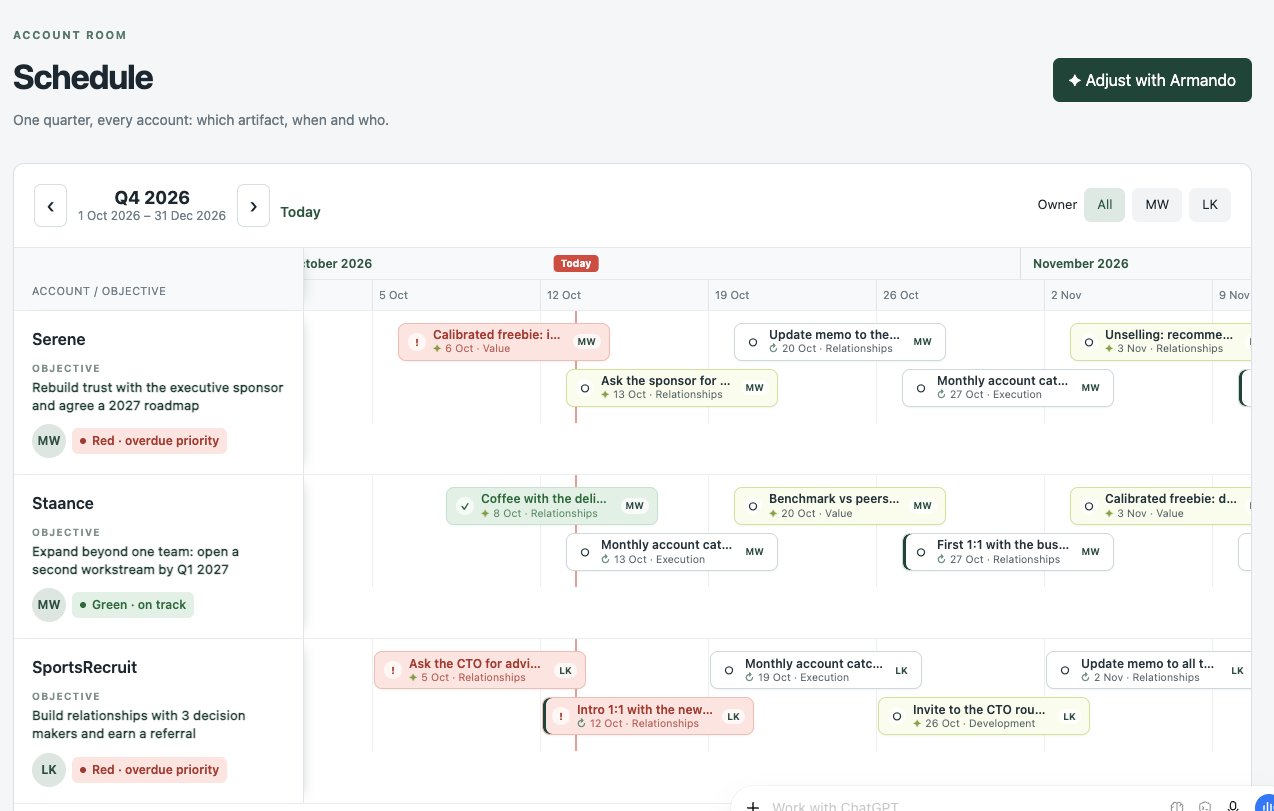
We divided the year into quarters and weeks, listed every client, assigned an owner, and tracked a few useful activities. It stopped account management from depending on memory and good intentions.
In my original post, I reported roughly 15% year-over-year revenue growth during the period, higher profitability on existing accounts, and more expansion work. I would not claim the spreadsheet caused all of that. The company, market, and team were changing at the same time. These are observations from our previous agency, not Armando customer results.
1. Build the smallest useful account sheet
List active ongoing clients and former clients worth reconnecting with. Give each account one owner. Start with the client’s priority and the next useful action—not a long list of services you want to sell.
The starter below is a reconstruction you can use today, not our original historical spreadsheet. Copy it into Google Sheets or your existing tool.
- Create columns for account, owner, quarter, client goal, activity, due date, status, next action, and evidence link.
- Choose the first activity because it addresses a real gap: unclear priorities, lost contact, an unresolved promise, or an opportunity to help.
- Record a short outcome after the activity. “Meeting completed” tells the next person less than “client confirmed priority; delivery lead to send options Friday.”
COPY & ADAPT
Account | Owner | Quarter | Client goal | Activity | Due date | Status | Outcome / evidence | Next action | Next date
Example account | Account owner | Q4 | Confirm next-quarter priorities | Sponsor conversation | Agreed date | Planned | Pending | Send short recap | Agreed date
2. Use our old rhythm as a starting point
Our pattern was roughly two meaningful touchpoints per quarter, one in-person meeting every six months, one or two useful contributions per quarter, and a quarterly review. We also tracked reconnection with former clients and follow-ups.
This is what we used, not a benchmark every agency should hit. Adapt it to the account, budget, client preferences, and your team’s capacity. An online conversation can be the right format; an in-person meeting is not automatically better.
- Meaningful touchpoint: learn something that changes your understanding or agree a useful decision.
- Useful contribution: give relevant context, a comparison, an introduction with permission, or a clearly bounded review.
- QBR: compare progress with client priorities and agree the next quarter.
- Follow-up: record the commitment, owner, date, and what done means.
3. Review execution every week
The hard part was never creating an account plan. It was getting people to follow through every week. Use a short internal review to decide where help is needed rather than turning the sheet into another reporting chore.
- Which important action is overdue, and why?
- Which client relationship has changed or gone quiet?
- Which commitment is blocked by someone outside the account team?
- Who owns the next action, and what happens before the next review?
4. Add detail only when it improves a decision
Later, we added annual account plans, stakeholder mapping, client priorities, delivery involvement, and clearer ownership. Those layers mattered because they helped people act—not because a more detailed spreadsheet looked mature.
Add a 12-month direction and a practical 90-day plan once the team can keep the basics current. Bring delivery into the conversation so commercial promises match what the team can do. Keep source notes and decisions accessible to a backup owner.
5. Answer the questions the story raises
Do you need 110 people for this? No. Start with the accounts you already have and a process your team can sustain. Headcount and revenue are context, not targets to copy.
Does account management replace marketing? No. In the discussion, I described our earlier acquisition work: blog posts answering client questions, Quora, SEO, and useful resources such as ebooks and calculators. That was our historical mix; it is not proof those channels will work the same way today.
Is more revenue the same as a healthier agency? No. Review delivery costs, account contribution, and company profitability alongside revenue. Do not use another agency’s revenue per person as a complete comparison of its service model.
6. Put it to work on one account today
Choose one ongoing account. Write its goal, owner, and next useful conversation. Agree a date, record what happened, and review the follow-through next week. Only expand the system when the team can keep that loop working.
Armando grew out of this execution problem: shared client context, tailored playbooks, and visible follow-through. You can start with the spreadsheet and templates below; the product is a way to support the rhythm, not a prerequisite for caring for your clients.
Start with one account this week
- Choose one ongoing client and one owner.
- Copy the starter sheet and confirm the client’s priority.
- Schedule one useful action and define done.
- Review its outcome and next step next week.
Common questions
Can I get a copy of the original spreadsheet?
The original file was not available in the supplied discussion. The downloadable CSV is a new starter based on the described fields and operating rhythm, with an illustrative row.
Did the spreadsheet cause the reported revenue growth?
We cannot isolate that effect. The post reports roughly 15% year-over-year revenue growth during the period and explicitly says the company, team, and market were changing too.
Adapted from Matt’s original agency story and discussion on Reddit. Practical templates and steps are adapted for this guide.