CLIENT RELATIONSHIPS · B2B AGENCIES
Build B2B client relationships: become useful beyond the status call
Practical B2B client relationship management for agencies: map stakeholders, hold useful conversations, keep promises, and preserve context through handovers.
Being pleasant helps. Being useful gives the relationship a reason to continue. A client should be able to point to the decisions, clarity, or progress your team made easier.
The goal is not to add networking meetings to a crowded calendar. Choose a conversation that answers a real gap in your understanding.
1. Map roles, not just contact details
Identify the sponsor, budget decision maker, business owner, and operational contact. One person may play several roles. For each, record what they care about, what they need from your team, and what you actually know versus assume.
- Ask your current contact who is affected by the work and who should help set priorities.
- Agree introductions instead of bypassing the person who brought you in.
- Keep the relationship map dated and limited to relevant professional context.
2. Ask about their work before talking about yours
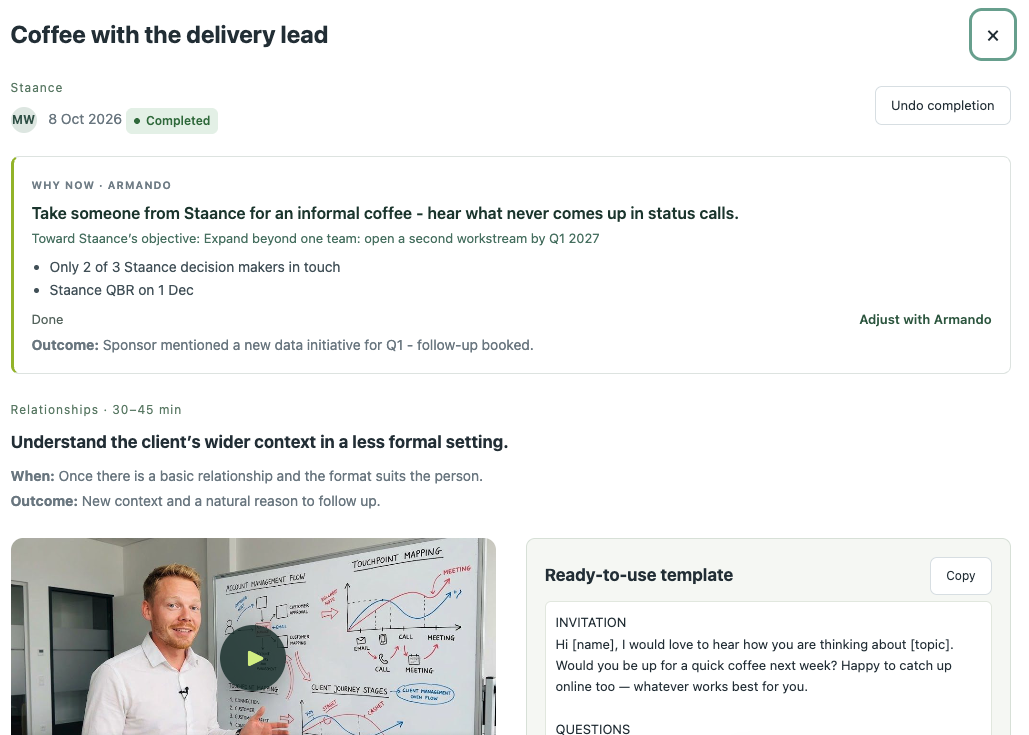
An informal coffee or online catch-up can surface context that a status call misses. Use it only when the format suits the person. Do not disguise a sales pitch as a friendly conversation.
COPY & ADAPT
I’d like to understand how you’re thinking about [relevant topic]. Would a short coffee or online catch-up be useful?

Questions: What is your team trying to achieve? What is making it difficult? What are we missing from our side? Is there one thing we could clarify or help you decide?
3. Offer a small, relevant piece of help
A concise memo, an introduction with permission, or a comparison of options can be more useful than a long presentation. Share the source and explain what you do not know. If the request becomes substantial work, agree scope and price rather than quietly absorbing it.
Sometimes the best advice is not to buy more from you. If the client’s proposed work will not serve their goal, explain the trade-off and suggest a better route. That is a practical way to act like an advisor; it is not a trick for manufacturing trust.
4. Keep the promise and close the loop
After the conversation, record the priority, the source, and the commitment. Send a short recap when it helps the client. Avoid turning every personal aside into a CRM field.
- Write one agreed next action with an owner and date.
- If you cannot meet the commitment, flag it before the date and agree the adjustment.
- At the next touchpoint, say what happened and ask whether it was useful.
- Update the account plan so the context survives a handover.
5. Choose a relationship rhythm the client wants
Delivery updates, business-priority conversations, and quarterly reviews serve different purposes. Combine them where practical. A smaller engagement may need a short review rather than separate meetings for every role. Ask the client how they want to work.
Measure your consistency through commitments kept and unanswered questions resolved. Stakeholder coverage can show a gap, but the number of meetings or contacts is not a measure of trust. Listen to what the client says and watch whether decisions become clearer.
Start with one account this week
- Find one stakeholder whose priorities you do not understand.
- Ask the existing contact for a purposeful introduction.
- Hold one conversation without a service pitch.
- Keep one promise and record the useful context.
Common questions
How do we avoid depending on a single client contact?
With that contact’s knowledge, meet the relevant business owner, sponsor, or decision maker. Make introductions useful to the work rather than treating people as names to collect.
How often should we meet clients informally?
There is no universal frequency. Use the person’s preferences, the account’s context, and a real purpose. Do not add meetings just to hit an activity target.