CLIENT RETENTION · B2B AGENCIES
How to reduce B2B client churn: a weekly retention routine
Practical B2B client retention strategies for agencies: spot relationship risk, talk to the right people, and follow through with a weekly action plan.
A client can be happy with delivery and still leave. Their budget changes, a sponsor moves on, or your work stops matching the problem they need to solve. The project board rarely tells you the whole story.
Start with one account you would hate to lose. You need its goals, key people, open commitments, and next commercial decision—not a complicated customer-success platform.
In our agency, the starting point was a quarterly sheet: client, owner, meaningful touchpoint, and evidence of what happened. The weekly loop mattered more than the format. The founder guide below explains that history.
1. Separate client health from execution health
Client health asks whether the relationship still has a reason to continue. Execution health asks whether your team is doing the agreed work. A completed task does not prove the client trusts you; a friendly sponsor does not excuse a missed promise.
- Write the client’s current business priority in their words. Add the source and date.
- Record the next renewal or budget decision, who makes it, and any known constraints.
- List unresolved complaints, missed commitments, and changes in contact. Mark unknown information as unknown.
2. Use a small health check, then investigate
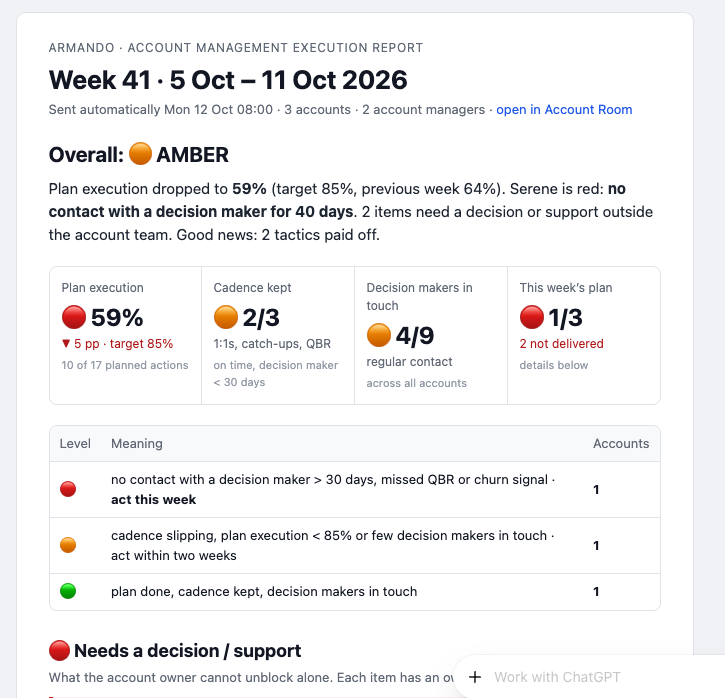
Use green, amber, and red as your team’s discussion shorthand. Green means goals are agreed, value has been discussed, and commitments are moving. Amber means something changed and needs checking. Red means a confirmed issue or an important commitment needs intervention. These are suggested operating definitions, not industry benchmarks.
Look for a change against that account’s usual rhythm. A slow reply during a holiday means something different from repeated silence before a renewal. Do not turn an arbitrary number of days into a churn prediction.
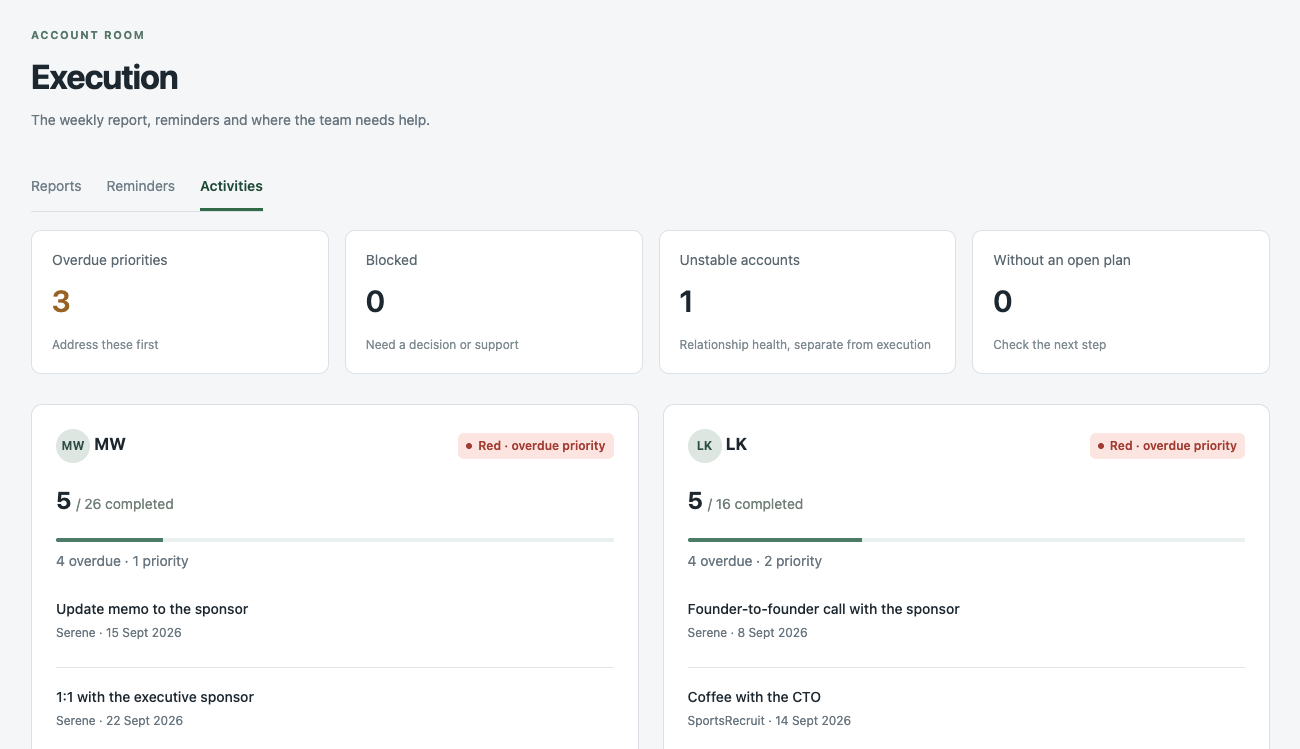
- Ask the account owner: what changed, and what evidence supports that view?
- Check contact with the sponsor and business owner, not only the delivery contact.
- Pick the most important gap. Write one action that could clarify or improve it.
3. Have the uncomfortable conversation early
Do not open with “are you going to cancel?” Start with the changed priority or missed expectation. Listen before offering a discount or another deliverable.
COPY & ADAPT
We agreed that [outcome] mattered. Since [specific change], I’m not sure our plan still fits. What matters most now? What is not working from your side? Let’s agree what we change, who owns it, and when we review it.
4. Agree a recovery plan you can actually deliver
For a delivery problem, bring the delivery lead into the plan. For lost sponsor access, ask the existing contact for a useful introduction. For a budget constraint, discuss a smaller agreed scope or a planned pause. More meetings alone do not fix any of these.
- Choose one or two changes with the client. Include what will stop as well as what will start.
- Assign an owner and date on both sides where needed.
- Send a short recap and confirm how you will judge improvement.
- Check the outcome at the next agreed touchpoint. Escalate a blocked commitment internally.
5. Measure retention without hiding contraction
For a defined period, client churn rate = clients lost from the opening client base ÷ clients at the start × 100. State what counts as a lost client; a completed one-off project may be a different category from a canceled ongoing engagement.
Also review revenue lost from cancellations and scope reductions. In a small agency, one account can swing the rate sharply, so show the count and reason beside the percentage. Track relationship activity separately: promises kept, risks resolved, and sponsor conversations. Those are process indicators, not proof of causation.
Start with one account this week
- Choose one account and verify its goal with the client.
- Check the next commercial decision and decision maker.
- Turn one risk into an action with an owner and date.
- Review the result next week—not just the color.
Common questions
Can a health score prevent churn?
No. It helps your team notice missing context and act sooner. Client budgets, priorities, and market changes remain outside your control.
Should we discount an at-risk account?
Diagnose the reason first. A discount will not repair poor delivery or a missing business case. If budget is the problem, agree a sustainable scope and price together.