PRICING ACCOUNT MANAGEMENT · B2B AGENCIES
How to bill for account management without surprise fees
How agencies can price account-management time: compare an inclusive retainer, a visible governance fee, and an agreed allowance with a cost example.
The problem usually appears slowly. A monthly check-in becomes weekly. Senior people join. Preparation and follow-ups multiply. Delivery revenue looks healthy while the account quietly consumes more capacity.
In Matt’s agency experience, he described trying PM hours, fixed monthly fees, and higher rates over the years. His preference for larger clients was to reflect a better service in the recurring price. That is a useful starting point—not a rule every agency must follow.
1. Measure the whole cost, not just time on the call
Track a representative period before changing pricing. A month is a practical starting sample; include unusually busy periods separately. Record preparation, meetings, internal coordination, follow-up, reporting, and issue resolution. Count every participant’s time.
Use your consistently defined hourly cost for each role. Include allocated employment costs and relevant overhead in the way your finance owner uses them. Do not confuse an internal cost rate with the rate quoted to the client.
- One hour with two agency people uses two person-hours before preparation.
- Separate delivery management from strategic relationship work so you can see what changed.
- Check which work is included in the current agreement before proposing a new charge.
COPY & ADAPT
MONTHLY ACCOUNT-MANAGEMENT COST
Role | Prep hours | Meeting hours | Follow-up hours | Internal hours | Cost per hour
Total role hours = prep + meetings + follow-up + internal
Estimated cost = sum of each role’s hours × its cost per hour
Add separately identified account-specific costs without counting them twice.
2. Choose how the client should see the price
The same underlying work can be packaged differently. Match the model to what the client is buying and how predictable the workload is. The line-item name does not fix a scope problem.
| Model | Useful when | What to define |
|---|---|---|
| Included in recurring fee | The relationship work is a predictable part of the service. | Meeting rhythm, reporting, senior involvement, escalation, and exclusions. |
| Separate strategy or governance fee | Cross-team coordination or senior advisory work is a distinct service. | Decisions and outputs it supports, who provides it, and its limits. |
| Agreed monthly allowance | Coordination varies materially and the client prefers a visible limit. | Included capacity, tracking, approval before extra work, and overage price. |
3. Check the arithmetic before choosing a percentage
Illustrative example in one currency: an account manager spends 8 hours at an internal cost of 60 per hour, and a senior lead spends 2 hours at 100. That is 680 of estimated cost. A fee of 1,000 for that defined work leaves 320 contribution, or 32%, before costs not included in the estimate.
These numbers illustrate the calculation; they are not recommended rates or a margin benchmark. A fixed percentage of a retainer can be a quoting shortcut, but it needs checking against actual workload. The busiest client may not be the one with the largest fee.
Review the full account contribution, including delivery and rework ↗
4. Describe the service in plain language
Clients can evaluate a service more easily than a vague “management charge.” Explain what they get: a named owner, preparation, decisions, reporting, and follow-through. Define the limits without making every ordinary question feel like a billable event.
COPY & ADAPT
Included relationship service: [named owner, agreed updates and reporting]
Meeting rhythm: [cadence, usual participants, purpose]
Senior involvement: [when and why]
Follow-through: [recap, actions, escalation route]
Additional coordination: [how we agree scope and price before starting]
Review date: [when we reassess the arrangement]
5. Reset an existing account before adding charges
If the work has grown, review the agreement and explain the change prospectively. Do not retroactively invoice an unexpected fee. Give the client a real option to narrow coordination or change the service. Follow the existing agreement’s approval and notice process.
Define the retainer service and its commercial boundaries ↗
COPY & ADAPT
Our involvement has changed from [old rhythm] to [new rhythm]. The additional work includes [specific preparation, decisions, and follow-through]. For the next period, we can provide that service at [fee], or keep the current budget with [narrower option]. Let’s agree the scope before the change starts.
6. Make the account owner responsible for a plan
Good account management is more than attendance. It connects client priorities, delivery risks, renewal, and relevant expansion opportunities. Review value and economics together. An expansion target does not justify unnecessary work or make every at-risk client worth saving at any cost.
Start with one account, cost its current rhythm, and agree one workable change. The objective is sustainable service and clear expectations—not getting the client to pay for every minute of being looked after.
Start with one account this week
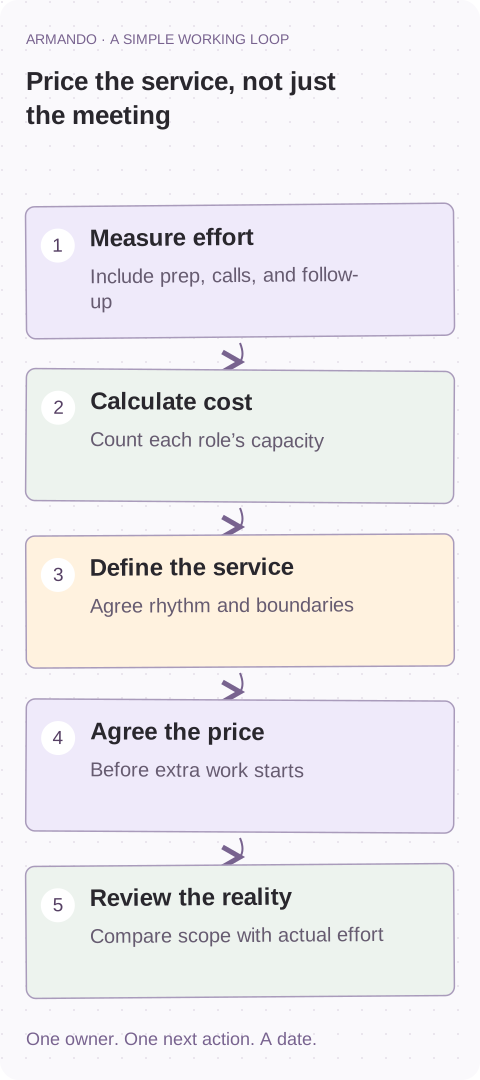
- Measure a representative period of AM effort by role.
- Check the current scope and calculate the estimated cost.
- Choose one pricing model with a clear service and limits.
- Agree any change before new fees or extra work start.
Common questions
Should account management be a separate invoice line?
Either an inclusive fee or a separate line can work. Cost the work in both cases and make the service, cadence, and boundaries clear in the agreement.
What percentage should we charge for account management?
There is no percentage that fits every account. Estimate effort and cost, choose the intended service economics, and compare the estimate with actual workload.
Can we charge for extra weekly meetings?
Agree the expanded coordination service and its price before starting it, using the current contract’s change process. First check what the client already reasonably expects within the agreed scope.