AGENCY PROFITABILITY · B2B AGENCIES
Improve agency profit margins: rates, scope, and delivery quality
Improve agency profit margins with account-level cost visibility, clearer scope, less rework, and practical scripts for pricing and change conversations.
A busy team can still be running an unprofitable account. Extra coordination, endless revisions, and small “quick favors” rarely appear in the original estimate. They still cost money.
Start with one account and one recent period. Make the hidden work visible before introducing a new pricing model or a blanket rate increase.
1. Separate revenue, account contribution, and EBITDA
For an internal account view, contribution = account revenue − directly attributable delivery and account-management costs. Contribution margin = contribution ÷ account revenue × 100. Define the costs consistently: allocated staff cost, subcontractors, and client-specific tools, for example. Do not count the same cost twice.
This is not automatically EBITDA. Company EBITDA also depends on the wider operating-cost structure and your accounting treatment. Work with the person responsible for your finances to align the account report with company reporting.
- Use revenue and costs from the same period.
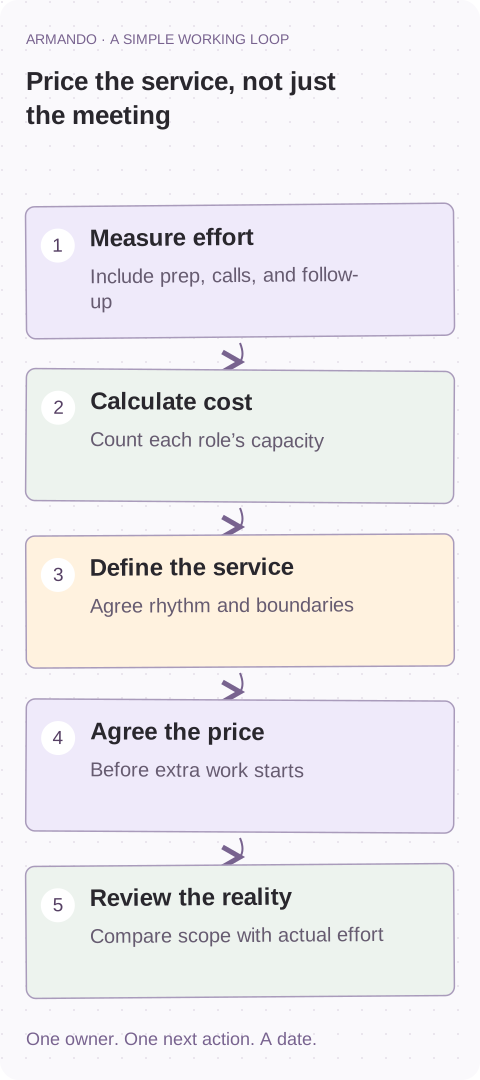
- Include meetings, preparation, revisions, and account coordination.
- Show write-offs and out-of-scope work separately.
- Compare estimated effort with actual effort and investigate the largest gap.
2. Reduce rework before blaming the rate
Rework can come from unclear requirements, missing client decisions, weak acceptance criteria, or a delivery defect. Separate those causes. Asking people to work faster will not fix a brief nobody agreed on.
- Agree what done means before starting a deliverable.
- Review high-risk work early enough to change direction.
- Record why a revision happened: defect, changed brief, or additional scope.
- Check recurring causes in the team review and change one process.
3. Make the scope conversation easy
A boundary is more useful when it comes with options. Ask the client whether to add budget, replace a lower-priority item, or schedule the request later. Do not treat every question as a change request; first check the agreement.
COPY & ADAPT
Hi [name], [request] could help with [goal]. It falls outside the scope we agreed. We can estimate the extra work and timing, or swap it for [lower-priority item] if the budget stays fixed. Which option fits your priorities? We’ll confirm the change before starting.
4. Discuss rates with a clear service and a real choice
Review rates when the service, seniority, capacity commitment, or economics need to change. Describe the work and limits the new fee covers. Explain the reason honestly; do not manufacture a value claim to avoid saying your costs or scope changed. Check the existing agreement and notice period.
COPY & ADAPT
For the next period, the fee for [defined scope] will be [amount] from [date]. This covers [service, capacity, and relationship work]. We can also keep the budget at [amount] by narrowing the scope to [option]. Let’s review which approach makes sense before we renew.
5. Run a short monthly margin review
Review account contribution, unplanned hours, rework causes, and approved scope changes together. Assign one action: clarify the brief, fix the QA gap, adjust the delivery mix, or discuss the commercial agreement. A spreadsheet is enough if its numbers are consistent and someone acts on them.
Illustrative example: revenue of 10,000 and defined direct costs of 7,000 leave 3,000 contribution, or 30%. An extra 1,000 of uncompensated work cuts that to 2,000, or 20%. These are arithmetic examples, not a recommended margin or an Armando customer result.
Start with one account this week
- Review one account’s actual contribution this month.
- Identify its largest source of unplanned work.
- Agree acceptance criteria for the next deliverable.
- Use the scope script before starting an extra request.
Common questions
Does raising rates always increase agency profit?
No. It depends on retained demand, delivery costs, and scope. Model the new agreement and its workload instead of assuming a higher rate fixes the account.
Should account management be charged separately?
It can be included in the service fee or priced separately. Either way, cost it and explain the responsibilities and meeting rhythm in the agreement.