AGENCY SALES & GROWTH · B2B AGENCIES
A B2B agency go-to-market plan for a more consistent sales pipeline
Build a practical B2B agency go-to-market strategy: pick a client problem, diagnose the sales bottleneck, test one channel, and track profitable work won.
Agency owners often ask which channel will produce another two clients or an extra amount of monthly revenue. The useful answer depends on the offer, sales cycle, delivery capacity, and where the current process loses opportunities.
Agency owners describe routes ranging from outbound to educational content, partnerships, and referrals. Treat those as options to test. Commenters’ conversion figures and vendor claims are not a benchmark for your agency.
1. Find the bottleneck before choosing a channel
Review a defined period and the deals behind the totals. Separate new-client acquisition, existing-client expansion, renewals, and one-off projects. They require different conversations and should not be merged into a single “MRR added” number.
Check account contribution alongside revenue won ↗
- Few relevant conversations: inspect targeting, message, channel, and proof.
- Conversations but no next step: check whether the problem is important and the buyer can act.
- Proposals but few decisions: examine scope, value, decision process, and unresolved objections.
- Work won but weak profit: fix pricing, delivery fit, and coordination costs before scaling activity.
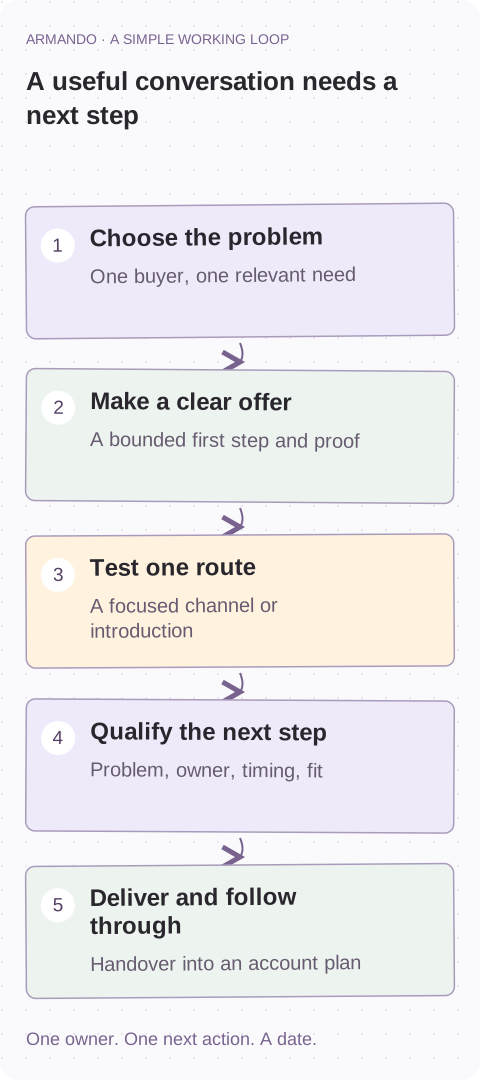
2. Describe one problem for one kind of buyer
Pick a segment where your team has useful experience and the capability to deliver. Define the role you speak with, the situation that makes the problem relevant, and the first paid step. A narrow starting offer does not prevent you from helping with wider needs later.
COPY & ADAPT
We help [specific team / role] facing [concrete problem].
We start with [bounded paid diagnostic or delivery step].
You get [output or decision the client can use].
Evidence: [approved example, relevant experience, or clearly labeled demonstration].
Fit limits: [what we do not provide].
Next step: [short conversation with a clear purpose].
3. Publish something useful before asking for attention
A practical teardown, checklist, or worked example helps a buyer understand how you think. Explain the problem, evidence, decision, and trade-off. If the example uses real client data, get permission and remove private information before publishing. Label illustrative numbers as examples.
Choose the format the intended audience already uses: an article, a short post, a training, or an industry conversation. Teach a useful part of the process. A service list with a different headline is not enough.
- Answer one question that repeatedly appears in discovery or client reviews.
- Show a concrete method a reader can apply without buying.
- Offer one relevant next step, such as a template or focused conversation.
- Record which content a prospect mentions, without assuming a last click explains the whole journey.
4. Test one acquisition route and one warm route
Keep the first test small enough to run consistently. For acquisition, choose a channel where you can reach relevant buyers. For a warm route, choose a purposeful partner introduction, a client referral after a confirmed win, or a relevant account-expansion conversation.
Set the test duration, effort budget, audience, and success criteria before starting. Follow channel rules and recipient preferences. Do not assume that a public interaction grants permission for automated messages, or that buying another tool solves weak positioning.
| Route | Useful starting condition | First test |
|---|---|---|
| Targeted outreach | You can identify a relevant business problem and appropriate contact. | A small researched cohort with a specific message and clear follow-up ownership. |
| Educational content | Buyers repeatedly ask a question you can answer with useful evidence. | One worked example distributed where that audience already learns. |
| Complementary partners | Another provider serves the same audience without the same offer. | One mutually useful conversation about fit and introductions with permission. |
| Client referrals or expansion | The client has confirmed value and has no unresolved major issue. | One relevant introduction request or problem conversation. |
Use a low-pressure referral request after a confirmed client win ↗
5. Give every interested conversation a next action
A positive response is not a qualified opportunity. Establish the problem, decision owner, timing, constraints, and whether your team is a fit. Agree a next step with a date and a useful output. If there is no fit, close the loop instead of keeping a misleading pipeline entry.
COPY & ADAPT
SALES NEXT-STEP NOTE
Source: [how the conversation started]
Client problem: [their words and evidence]
Decision owner / process: [confirmed or unknown]
Timing and constraints: [what we know]
Next action: [output / owner / date]
Fit and capacity: [what needs checking]
Outcome: [continue, nurture with permission, or close]
6. Measure useful conversations and sustainable work
Show counts as well as rates: relevant conversations, qualified opportunities, proposals, decisions, work won, sales effort, and contribution after delivery costs. Use the same stage definitions and follow cohorts long enough for your sales cycle. A two-week snapshot can miss the eventual result.
For a target of two new engagements, illustrative planning might assume a 25% opportunity-to-win rate and therefore eight qualified opportunities. That is arithmetic, not a forecast or industry benchmark. Use your own observed rate, sample size, and sales-cycle length before estimating capacity.
Recurring contracted revenue is different from a one-off project fee or unsigned proposal. Report them separately. After a win, a clear onboarding and account plan keeps the promises made in sales connected to delivery.
Hand a won engagement into a practical onboarding plan ↗
Build a weekly account-management rhythm alongside acquisition ↗
Start with one account this week
- Review the last few opportunities and name the biggest bottleneck.
- Write one buyer/problem/offer statement with honest proof.
- Choose one acquisition test and one warm route.
- Track next actions, work won, and contribution—not only activity.
Common questions
Which GTM channel is best for a B2B agency?
There is no universal winner. Choose based on your buyer, offer, evidence, available effort, and current sales bottleneck. Run a bounded test before adding more channels.
How do we close two agency deals a month?
Work backward from your own qualified-opportunity win rate and sales cycle, then diagnose whether the gap is targeting, conversations, decisions, or capacity. A channel or activity count cannot guarantee that result.
Is a new project the same as additional MRR?
No. A one-off project fee is project revenue. Monthly recurring revenue should represent the recurring contracted component under a consistent definition; do not include unsigned pipeline.